Assessment, feedback, and development in the same intranet flow

Create assessment cycles, collect responses, follow manager validations, and connect next steps to goals, development plans, and training.

Cycles • Questions and responses • Manager validation • Development plans, goals, and history

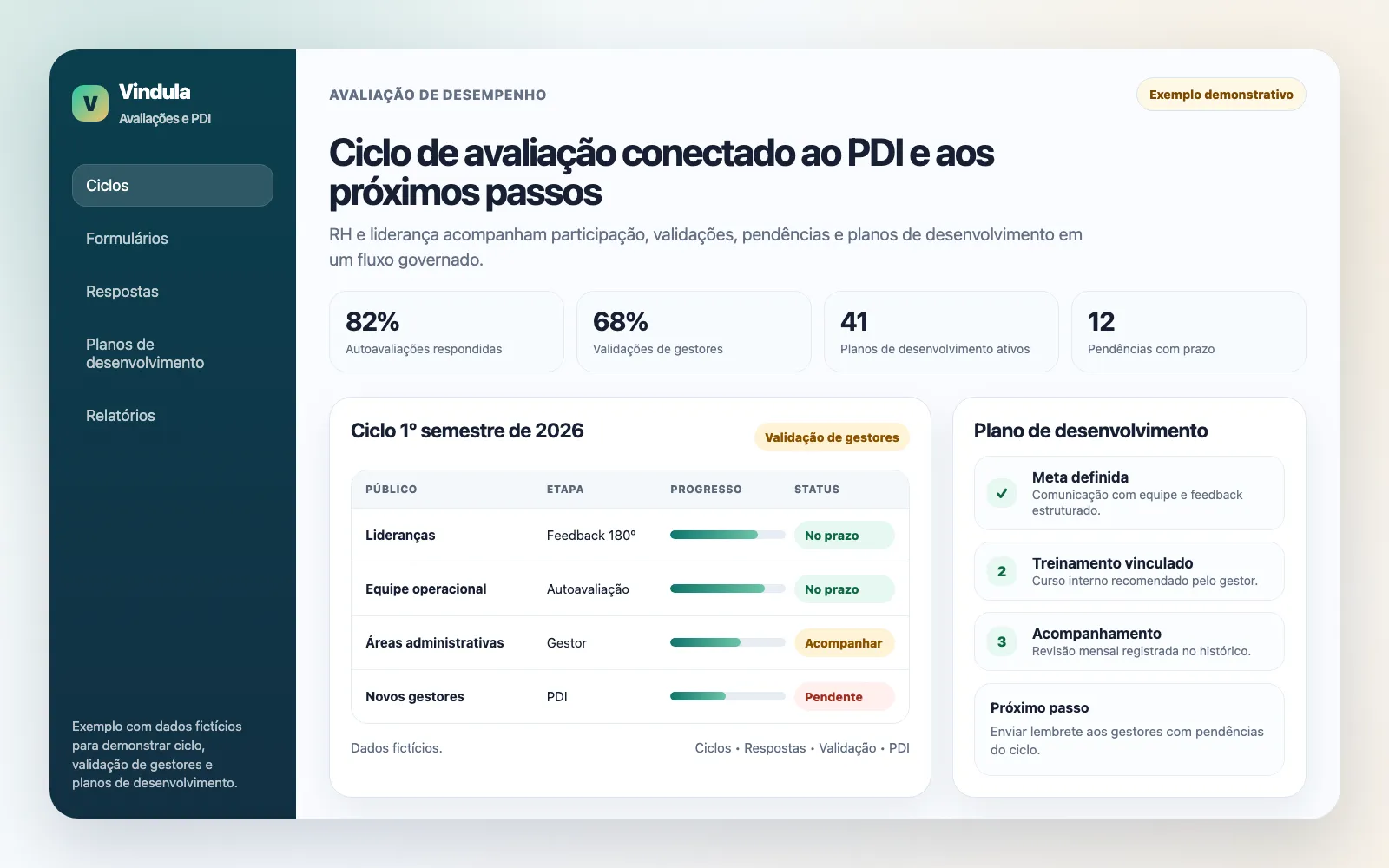
Illustrative example of a performance assessment and development plan cycle tracked in Vindula

Illustrative example: HR and managers follow cycle stages, responses, pending items, and development plans.

Module capabilities

What Assessments and Development Plans includes

Organize the full cycle: templates, audiences, responses, validations, pending items, goals, and development plans.

Cycles and templates

The structure to turn assessments into a recurring process, not a loose spreadsheet.

  • Assessment cycles

    Creation and organization of cycles by context, audience, and assessment goal.

  • Response templates

    Standards to structure responses, criteria, and scales consistently.

  • Questions and blocks

    Form organization with questions, sections, and cycle composition.

  • Audience by context

    Use of people, areas, units, and roles to apply the cycle to the right audience.

Responses and follow-up

Operations track participation, pending items, and validations without losing cycle history.

  • Employee assessments

    Area to track assessments pending, in progress, and completed by the employee.

  • Manager validation

    Flow for leadership to review, validate, and follow responses when the cycle requires it.

  • Status and pending items

    Tracking who responded, who still needs to act, and where the cycle stalled.

  • Structured feedback

    Formal record of comments, perceptions, and feedback inside the employee context.

Development plans, goals, and growth

The cycle gains continuity when assessment, goals, and development plans stay connected.

  • Individual development plan

    Record of actions, next steps, and evolution agreed between employee and leadership.

  • Goals and objectives

    Tracking goals tied to the development journey.

  • Manager and employee in the same flow

    Shared routine to align expectations, feedback, and actions.

  • Connection with training

    Plans can guide learning paths, content, and training that support development.

Reporting and governance

Process management with visibility, history, and administrative control.

  • Cycle reports

    Operational view of progress, completion, and points that need action.

  • History by person

    Consultation of assessment and plan history in the employee context.

  • Administrative permissions

    Controls to separate operations, leadership, HR, and process administration.

  • Organizational context

    The cycle uses the people, roles, departments, and units already maintained in the platform.

Operational control

What HR and leadership start controlling

The value is moving the assessment cycle out of isolated spreadsheets and placing questions, audience, responses, pending items, and development plans in the same people context.

Define questions, blocks, and templates before opening the cycle to employees.

Apply assessments to the right audience using people, departments, roles, and units.

Track responses, pending items, and manager validations during the cycle.

Turn assessment outcomes into development plans, goals, and action items.

Keep history by employee without relying on parallel controls.

Connect next steps with training, communication, and HR routines when relevant.

Best fit

Where this module usually makes the most sense

The gain appears when assessment stops being an isolated event and starts supporting development, history, and context-based management.

01

Recurring assessment cycles

When the company needs to standardize stages, questions, audiences, and follow-up.

02

Managers tracking development

For routines where leadership needs to validate responses, align goals, and follow development plans.

03

Multi-unit operations

When different audiences, roles, and structures need to enter the same process.

04

HR with formal history

When assessment, feedback, and development need a consultable trail.

FAQ

What usually comes up in assessment conversations

See how the module fits formal cycles, structured feedback, development plans, and leadership follow-up.

Does the module replace HR?

No. Assessments and development plans complement the HR foundation. The module uses employees, roles, departments, and units to apply cycles and track development.

Can it support development plans?

Yes. Development plans work as cycle continuity: responses and feedback can guide goals, actions, and next steps between employee and leadership.

Is it for formal assessments or lighter feedback?

The module is best suited for structured assessments with cycles, questions, responses, follow-up, and history. Lighter feedback can fit when it belongs to that flow.

How does it connect with Training?

When an assessment identifies a development need, the plan can point to learning paths, courses, or official content in the Training module.

Who follows the cycles?

HR, leadership, and process administrators can follow responses, pending items, validations, and history according to permissions and operating design.

Want to see how Assessments and Development Plans fit your HR flow?

The guided demo starts from your HR, leadership, and training scenario to show where the cycle should begin.